Magnesium Amino Acid Chelate 40% Granular: An Exhaustive Clinical and Pharmacokinetic Analysis
A research-grade analysis of Magnesium Amino Acid Chelate 40% Granular — the buffered chelate behind Mt. Angel Vitamins' Good Magnesium — covering chemistry, bioavailability, absorption pathways, and manufacturing advantages versus pure bisglycinate, citrate, and oxide.
Companion infographic: View the interactive Magnesium Chelate 40% Granular visual — yield doughnut, bioavailability bars, manufacturing radar, and pharmacokinetic curves.
1. Introduction: Why Magnesium Form Matters
Magnesium is an essential intracellular cation and a critical cofactor in more than 300 enzymatic reactions — from ATP stabilization and neuromuscular transmission to DNA/RNA synthesis and skeletal mineralization. Despite this, epidemiological surveys consistently show that up to two-thirds of the Western population fails to meet the Recommended Dietary Allowance (RDA) for magnesium through diet alone.
The central challenge in oral magnesium supplementation is not the elemental dose ingested, but the fraction actually absorbed across the intestinal wall. Inorganic salts like magnesium oxide, carbonate, and sulfate are cheap and dense in elemental magnesium, but they are poorly soluble at neutral pH and largely unabsorbed. The unabsorbed fraction draws water osmotically into the gut, frequently producing diarrhea and gastrointestinal distress that crushes patient compliance.
Chelation was developed to solve this. An inorganic magnesium ion is covalently bonded to one or more organic ligands — most commonly amino acids like glycine, lysine, or taurine — forming a stable ring structure that surrounds and protects the central mineral. The chelate shields magnesium from dietary inhibitors (phytates, phosphates) and routes it through active dipeptide transporters rather than saturable ion channels.
Magnesium Amino Acid Chelate 40% Granular is a specifically engineered, industrially optimized matrix that bridges the trade-off between dense elemental yield and gentle, high-bioavailability chelated absorption. It is the form used in Mt. Angel Vitamins'' Good Magnesium.
2. Chemical Architecture and Stoichiometry
2.1 The Elemental-Weight Paradigm
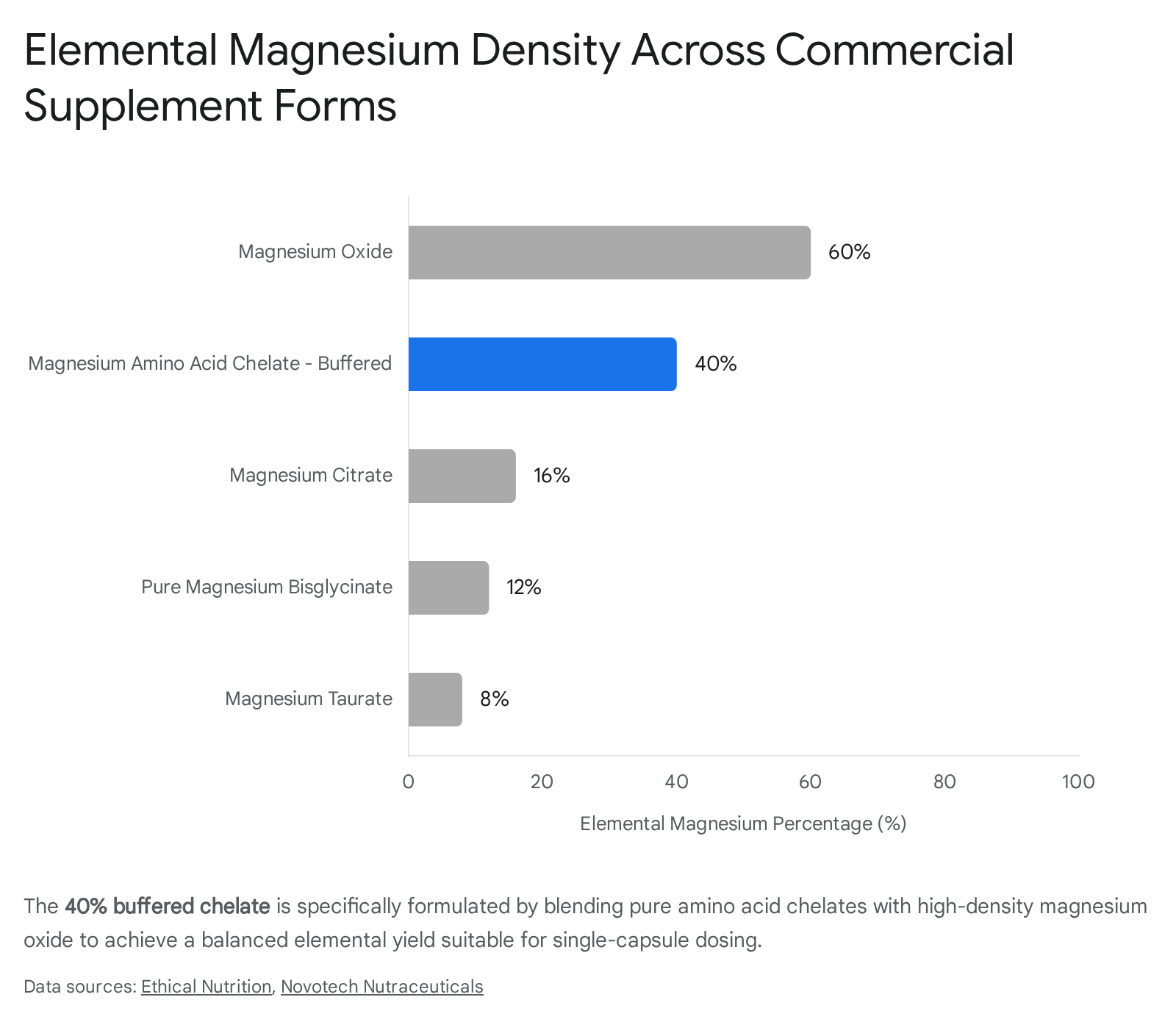
Pure, fully reacted magnesium bisglycinate binds one Mg²⁺ to two glycine molecules. Because glycine carries far more molecular weight than the central magnesium ion, pure bisglycinate yields only ~10–14% elemental magnesium by weight. To deliver 400 mg of elemental Mg from pure bisglycinate, a formulator needs roughly 2,850 mg of raw material — too much for a single capsule.
A 40% elemental yield is chemically impossible in a fully reacted 1:2 stoichiometry. It identifies the material as a buffered chelate: a deliberate co-process of fully reacted amino acid chelate with magnesium oxide (~60% elemental Mg) to lift the average yield to a manufacturing-friendly 40%.
| Form | Elemental Mg | Bioavailability Score |
|---|---|---|
| Magnesium Oxide | ~60% | 12 |
| Magnesium Chelate 40% (Buffered) | ~40% | 85 |
| Magnesium Citrate | ~16% | 65 |
| Pure Magnesium Bisglycinate | ~12% | 92 |
2.2 Granular Morphology
Beyond chemistry, the physical form of the 40% chelate is decisive. Granulation agglomerates fine primary particles into larger, cohesive granules with controlled bulk density, low dust, and excellent flowability. The result:
- Light yellow granular powder, moisture <5%, pH 4–6.
- Each granule co-processes the fully reacted chelate fraction with the oxide buffer fraction into one functioning excipient.
- Excellent flow through high-speed encapsulation hoppers — no bridging, no clogging, minimal capsule weight variance.
- Direct-compression tablet capability, cutting down on excipient binders and wet-granulation steps.
3. Bioavailability and the Cellular Absorption Pathway
3.1 Two Absorption Mechanisms
Standard ionic magnesium (oxide, sulfate) relies on passive diffusion and the TRPM6/TRPM7 ion channels in the small intestine — both easily saturated and competitively inhibited by other divalent cations (Ca²⁺, Fe²⁺, Zn²⁺).
Chelated magnesium uses a fundamentally different route: the PEPT1 dipeptide transporter in the jejunum. The intact chelate molecule is recognized as a dipeptide-like substrate and actively transported into the enterocyte, where it is later cleaved in plasma to release free Mg²⁺ to target tissues.
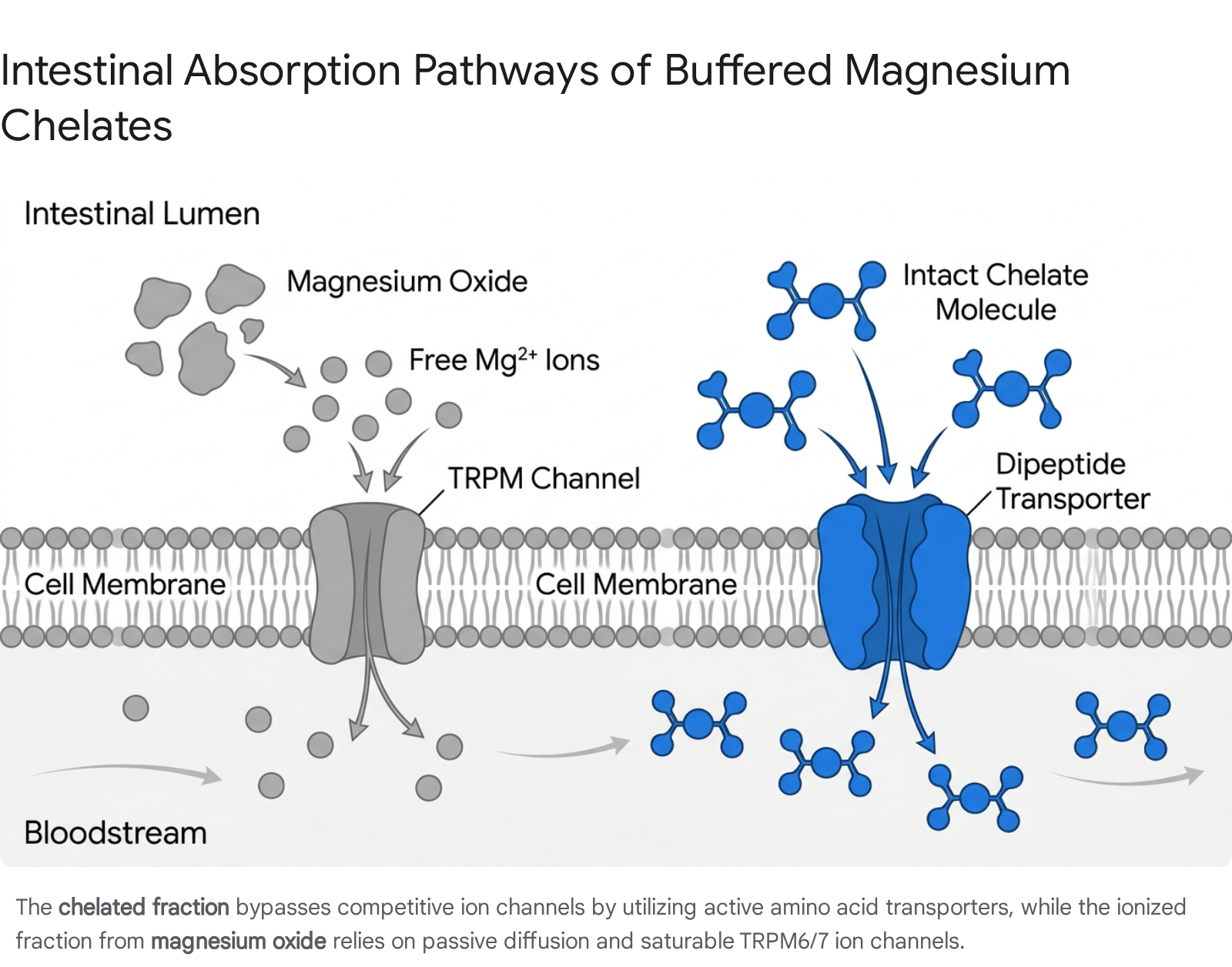
The 40% buffered chelate delivers both pathways simultaneously: the chelated fraction bypasses ion-channel competition via PEPT1, while the oxide fraction provides additional ionic Mg²⁺ that can move passively when the chelated route is saturated.
3.2 Pharmacokinetic Profile
Theoretical serum modeling at a 400 mg elemental dose shows:
- Magnesium Oxide: small, blunted curve — peak ~0.95 mmol/L at 3 h, low AUC, high osmotic load.
- Pure Bisglycinate: sharp peak ~1.30 mmol/L at 3 h, fast taper.
- Magnesium Chelate 40%: rapid rise to ~1.25 mmol/L at 3 h with a sustained plateau through hour 6 — combining the absorption kinetics of chelate with the depot effect of the buffered oxide fraction.
4. Clinical Efficacy
Magnesium repletion via highly bioavailable chelated forms has been investigated across multiple clinical domains:
- Sleep & Stress: Magnesium is a co-factor in GABAergic signaling and HPA-axis modulation. Trials of bioavailable magnesium forms report improvements in sleep latency, sleep quality, and subjective stress scores within 4–8 weeks.
- Neuromuscular Cramping: Magnesium repletion reduces frequency and severity of nocturnal leg cramps, exercise-associated muscle cramps, and tension-type headaches.
- Cardiovascular & Metabolic: Adequate magnesium status supports endothelial function, normal blood pressure, glucose disposal, and insulin sensitivity. Chelated forms produce more reliable serum elevation with less GI distress than oxide.
- Bone Mineralization: Magnesium is required for vitamin D activation and parathyroid hormone regulation; chronic deficiency impairs bone density independently of calcium intake.
5. Manufacturing Advantages of the Granular Form
The "Granular" specification is not cosmetic. In a contract-manufacturing setting it materially affects yield, cost, and finished-product quality:
| Attribute | 40% Chelate (Granular) | Standard Mg Powder |
|---|---|---|
| Flowability | 95 / 100 | 40 |
| Compressibility | 90 / 100 | 55 |
| Low Dusting | 98 / 100 | 30 |
| Bulk Density | 85 / 100 | 60 |
| Blend Uniformity | 92 / 100 | 50 |
Low dust protects equipment and operators. High bulk density allows higher elemental dosing per capsule. Excellent compressibility enables direct-compression tablets without the heavy excipient load that dilutes finished-product potency.
6. Why Mt. Angel Vitamins Chose the 40% Buffered Chelate
A formulator faces a binary choice: deliver a clinically meaningful 300–400 mg elemental dose in a swallowable single capsule, or use a pure chelate and ship a horse-pill that patients abandon. The 40% buffered chelate resolves that constraint:
- One capsule can deliver a clinically relevant elemental dose.
- The chelated fraction preserves the gentle, high-absorption profile that pure bisglycinate is famous for.
- The oxide buffer adds depot-style sustained release without the laxative penalty of unbuffered oxide alone.
This is the exact form used in Good Magnesium — bioavailable, gentle on the gut, and dosed for real-world muscle, sleep, and stress support.
7. Conclusion
Magnesium Amino Acid Chelate 40% Granular is the most pragmatic form available to modern supplement formulators. It marries the absorption advantages of fully reacted amino acid chelation with the elemental density of inorganic oxide, all in a granular morphology engineered for clean manufacturing. For consumers, the result is a single capsule that delivers a meaningful dose of magnesium without the GI distress that derails compliance.
Bottom line
The 40% buffered amino acid chelate combines the gentle, high-bioavailability absorption of pure chelates with the elemental density of magnesium oxide — making a clinically meaningful, single-capsule dose possible without the GI distress of unbuffered oxide.
FAQ
What does '40% Granular' mean on a magnesium chelate label?
It means the raw material delivers 40% elemental magnesium by weight (a buffered blend of fully reacted amino acid chelate with magnesium oxide), supplied in a granulated physical form optimized for capsule and tablet manufacturing.
Is buffered magnesium chelate as well absorbed as pure bisglycinate?
Bioavailability is closely comparable. The chelated fraction is absorbed via the PEPT1 dipeptide transporter, bypassing the saturable TRPM6/7 ion channels that bottleneck pure ionic forms like oxide.
Why not just use pure magnesium bisglycinate?
Pure bisglycinate yields only ~10-14% elemental magnesium. A clinically meaningful 400 mg elemental dose would require ~2,850 mg of raw material — too large for a single swallowable capsule.
Will this form cause diarrhea like magnesium oxide?
Significantly less. The chelated fraction is actively absorbed, reducing the unabsorbed osmotic load that drives oxide-induced diarrhea.